
LIGHT FROM THE SUN
Let’s take a step back for a second. Light is essential for photosynthesis as we’ve seen in part 1. But what is light exactly? There’s some physics to get our heads around before we dive into this. It’s important for me to get a sense of this part of the process. Photosynthesis occurs in plants, but it’s really a story about the relationship between these little green organisms in the soil and oceans, and our star out there in space. The sun burns, pulsates and explodes. It affects my skin easily from its vast distance, turning me freckly, burning me if I’m not careful. But it also radiates, bringing warmth, life, joy, optimism. The sun, whether in cosmic or mundane ways, orchestrates our lives, when we sleep, when we wake up, how we feel.
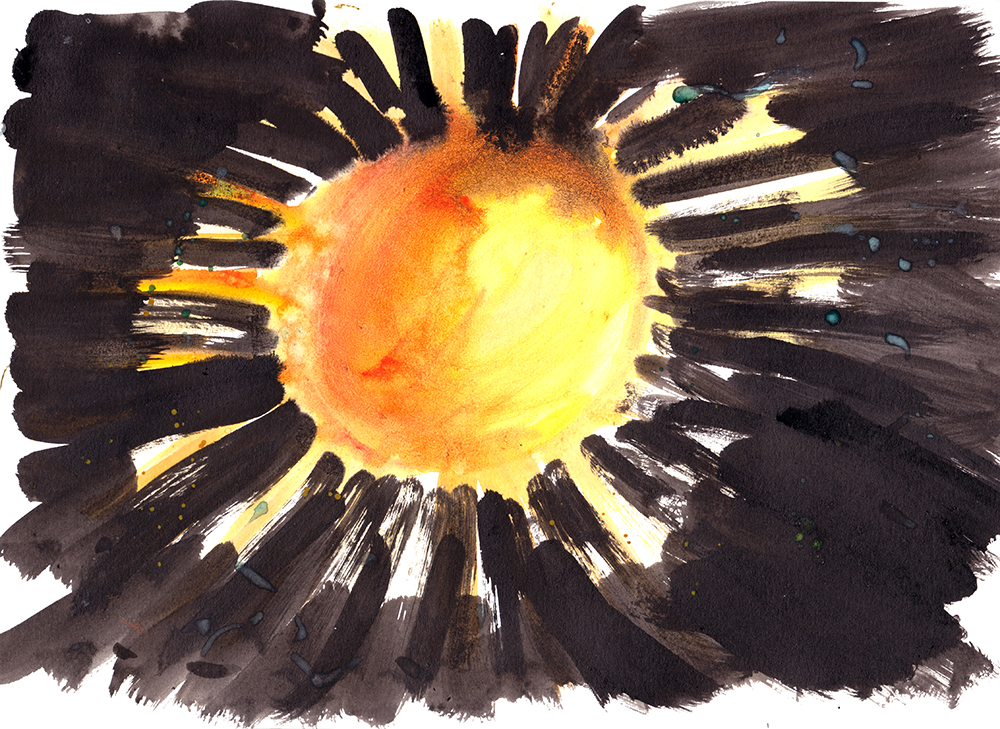
Our star is a throbbing mass of energy. Mass can be pretty small and still generate a huge number. The conversion of hydrogen into helium in the Sun creates enormous amounts of energy per second. This radiates out into the Universe and a tiny sliver of it hits the Earth, some 93 million miles (150,000,000 km) away. Plants have evolved on Earth to capture that energy, use it to split water, to take the electrons from that process to power the creation of chemicals that enable it to fix carbon dioxide into sugars. Interestingly, you cannot just expose water to sunlight to do this. Even though the light obviously has the energy, and water can be split, it takes the structure of the chloroplast, with chlorophyll at its heart, to do it. Chlorophyll has a particular structure of single and double bonds which can trap and harness this energy. The process of photosynthesis is so unique and finely tuned to this role that it has barely evolved in nearly 2.5 billion years [1].
But before we get to that, let’s think again about our sun. It is just one of trillions of stars out there in the Universe. Stars are not randomly spread across the Universe, but gathered together in clusters, or rather galaxies. The European Space Agency estimates that there are 1011 to 1012 stars in our galaxy, and there’s something like 1011 or 1012 galaxies.[2] By this reckoning, there will be about 1022 to 1024 stars in the Universe – a mind-frying number to try and get your head around.[3]
Stars form inside cold clouds of dust and gas, consisting mostly of hydrogen (as we’ll see later), called nebulae. This is nicely explained by the National Geographic [4]. To paraphrase slightly, these clouds can be turbulent and pockets of dense matter form within them. Gravity will make these pockets start to collapse under their weight, heating it up. When this collapsing pocket gets to a certain size it is called ‘pre-stellar’. It eventually forms a ‘core’ and as this condensing process goes on, the core starts to spin and gets faster and faster, because of the conservation of angular momentum – “the same principle that causes a spinning ice skater to accelerate when he or she pulls in their arms”. After about 50,000 years, a disk will have formed around the central core, and excess material will be ejected outward from the poles of the star. Apparently, a pole on a star is like those on the Earth, defined as the axis that the star spins around. If you picture this excess material being ejected, it will be like fountains springing from opposite sides of the circular core. The rotation of the core and the release of this material “causes a flat disk to form around the pre-stellar core, similar to the way a dress forms a flat disk around a spinning ice-skater”, explains the Frontiers for Young Minds website.[5] And yep, there’s a few ice-skater analogies in the physics of star creation it seems!
The fountains, or ‘jets’, that appear at the poles keep the system in balance, and it has now progressed into a ‘proto-star’. The system keeps spinning and some of the disk material, which is mostly gas, will be absorbed into the core, causing it to grow in size. Over the next 1,000 years, the core will become big enough and dense enough for nuclear reactions to take place, causing it to ‘shine’. It is now a ‘T-tauri star’ and it will become visible for the first time. Before this, astronomers might be able to detect its presence but until it shines, due to the nuclear reactions taking place, it cannot be seen directly.
We’ll get to the nuclear reactions in a moment. Over time, the star will stop absorbing any of the disk and the excess material may start to clump together to form planets, which will orbit the star, forming a solar system, just like our own, the Milky Way.
This is how our star formed, but whether this is how all stars form seems to be open to debate. I think that most supergiant stars are just stars reaching the end of their lives, and in general, it seems that the bigger the star the shorter its lifetime, comparatively speaking of course. Most stars exist for billions of years. What about hypergiants? That’s for another time. It makes me wonder if starlight, as in light from stars rather than from our own sun, plays any part in photosynthesis. I think the answer is no, possibly because it has taken so long to be even be visible to our eyes, let alone reach Earth. And it won’t have the intensity required for photosynthesis, but that’s just what I’m inferring from what I’ve read.
In any case, that’s how our sun came to shine, so let’s get on with figuring out what light is.
WHAT IS LIGHT?
The central nucleus of an atom holds vast amounts of ‘stored’ energy and nuclear fusion is a way that this energy can be released. It is a nuclear reaction (a reaction which brings about a change in the nucleus).
Nuclear fusion is the collision and combination of two ‘light’ (as in ‘not heavy’) nuclei to form a heavier, more stable nucleus, with the release of large amounts of energy. It requires temperatures of millions of degrees Celsius, to give the nuclei enough kinetic energy for them to fuse when they collide (the high temperatures mean it is called a ‘thermonuclear reaction’). It only occurs naturally in stars, including our own sun.
Within the sun, hydrogen ions (that is, lone protons without an electron) are being converted into helium, resulting in the release of huge amounts of energy in the form of electromagnetic waves (or light). It’s important to note here though that it is not just hydrogen being converted into helium that generates or releases the energy we see as light. Indeed, that conversion requires several steps, and some of those steps are hydrogen turning into other forms hydrogen and helium turning into other forms hydrogen. These steps give off just as much energy, if not more, than hydrogen into helium. This has been explained by astrophysicist Ethan Siegel [6].
Hydrogen is normally found as H2, which means with 1 proton and 1 neutron, in which case the mass is double and it is called ‘deuterium’ instead. Hydrogen ions will normally avoid each other due to their positive charges, but in certain conditions (such as in the sun) they do collide and stick together to form helium. In this reaction, mass is lost.
There are actually several ways in which hydrogen can become helium, but as I understand it the most common journey is as follows: hydrogen atoms collide to form deuterium, another form of hydrogen, (releasing a positron and a neutrino as one proton changes into a neutron – I think this is called beta decay!). After it is formed, deuterium fuses with another proton to produce the light isotope of helium, 3He (2 protons, 1 neutron). This happens extremely fast and it is predicted that deuterium nuclei last for about 4 seconds before being converted into 3He. There are four pathways from here, but the most common is called p-p l (a proton–proton chain reaction) in which two 3He fuse to form helium-4 (2 protons, 2 neutrons), resulting in the release of 2 protons [7].
The energy released by this reaction can be buried within the sun and take over 100,000 years to reach the sun’s surface, where it is radiated out into space and travels the 93 million miles to Earth [8]. Some of this energy, in the form of photons of light, falls on plant leaves and when it reaches the chloroplast, the energy is used to split water – turning H2O into free oxygen, electrons, and two hydrogen ions (atoms electrically charged by the loss or gain of electrons).
I should mention there is a difference in mass between individual particles and the same number of particles when fused together to form other atoms. So, 6 protons, 6 neutrons and 6 electrons have a certain mass. Combine them to form oxygen12 and they will be lighter. This sounds a little crazy, but the reason is that some mass has been converted into the energy necessary to hold the atom together. In an atom, there is the same number of protons and electrons. If an atom loses or gains an electron, it becomes ionised. With equal numbers of protons and electrons, the positive and negative charges are cancelled out. When an atom is ionised, the charge is changed.
It’s worth remembering here that hydrogen is the most common chemical substance in the Universe, accounting for approximately 75% of all mass (careful – it might not be all mass as such). The second most abundant substance is helium, with approximately 24%. All other substances fall within the remaining 1% of stuff.
The reason why hydrogen is so abundant is because it is so simple, just one proton and one electron. Helium is also very simple, and that simplicity makes them very common. This abundance is mind boggling in its size and is why amazing things can happen which creates the energy of the sun.
Continued in Part 3…
Footnotes:
[1] There are actually a few different kinds of photosynthesis, or rather variations on a theme. They all do essentially the same thing. I’m describing the most prevalent type of photosynthesis, otherwise known as C3 photosynthesis. The other main types are called C4 photosynthesis and CAM (or Crassulacean acid metabolism), and these forms are only selectively advantageous in very particular conditions.
[2]http://www.esa.int/Science_Exploration/Space_Science/Herschel/How_many_stars_are_there_in_the_Universe
[3] But let’s try. It is whatever 10 x 10 x 10 x 10 x 10 x 10 x 10 x 10 x 10 x 10 x 10 x 10 x 10 x 10 x 10 x 10 x 10 x 10 x 10 x 10 x 10 x 10 x 10 x 10 x 10 x 10 equals…
[4] https://www.nationalgeographic.com/science/space/universe/stars/
[5] https://kids.frontiersin.org/article/10.3389/frym.2019.00092
[7] We’re stretching my ability to summarise here, so check out this Britannica description of the proton-proton-chain: https://www.britannica.com/science/proton-proton-cycle
[8] There are some wonderful facts about the sun on the Nasa website here: https://science.nasa.gov/sun/facts/
 thesideshoots.com